Crop stages: evidence review for cereals, fruit and protected crops
A fourteen-day evidence review with crop-specific stage and risk checklists for tomatoes, cereals, olives, citrus, grapes, strawberries, bananas and orchards. Adapt dates to observed development; no application rates.
License: cc-by-4.0
crop-stages, scouting, wheat, olive, citrus, grape, strawberry, banana, orchard, greenhouse
Overview
Crop stages: evidence review for cereals, fruit and protected crops
Scope and assumptions
This is an original educational workflow, not a field-validated production protocol. Its fourteen days are a review cycle, not crop-stage durations or a maturity forecast. Use the actual cultivar, production system, region and observed stage. Established measurement principles are distinguished from illustrative record design; all numerical exercises and supplied data are synthetic. No experimental efficacy or yield result is supplied.
Adapt the plan privately, retain the source version and license, and replace example dates with locally appropriate review dates. Identify the field and planting, soil or substrate, irrigation system, weather source and responsible reviewer. Obtain the laboratory’s sampling instructions. Separate planned tasks from completed operations and do not create input quantities until an authorized local plan supplies them.
Measurements and data quality
Record identifiers, date/time with timezone, method, depth or spatial coverage, unit and quality flag. Keep measured observations, estimates, forecasts and synthetic records explicitly separate. A missing value stays blank/null; zero is a value and requires evidence. Preserve raw suspect readings and flag them. Compare like methods, units and growth stages. Soil-test concentrations are not fertilizer rates. Photographs and satellite indices guide inspection, not a definitive disease or nutrient diagnosis.
Editable review steps
0 · Define the field and current stage
Record field/planting identifiers, cultivar, system, actual growth stage and review question. Use the crop checklist below. Deliver a dated context card and identify missing evidence.
1 · Check soil, water and observation methods
Attach report references, sample methods and dates; verify units, sensor depth and quality flags. Keep actual measurements separate from estimates and missing data. Deliver an auditable evidence register.
3 · Inspect crop and delivery conditions
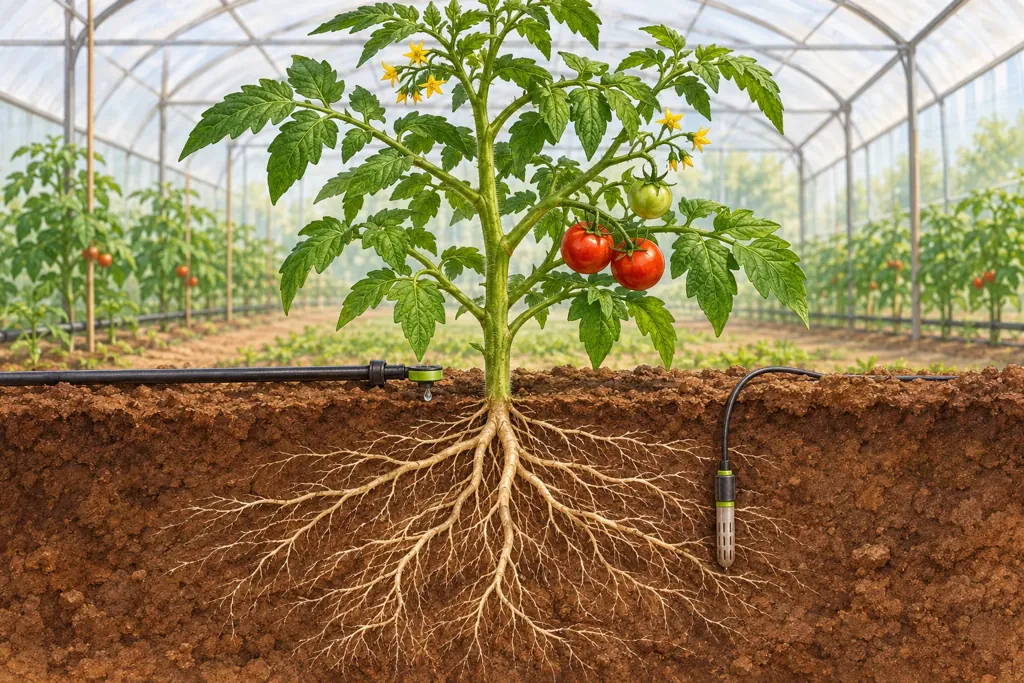
Use repeatable observation points and record counts with denominators. Review root-zone condition and irrigation delivery. Escalate unexplained symptoms; do not diagnose from a photo or index. Deliver observations and a review request.
7 · Review the proposed decision
Reconcile the locally approved nutrient or water plan with actual records. Check arithmetic and assumptions. Record approve, revise, defer or no intervention with a responsible reviewer; a task is not an application command.
14 · Reconcile actual work and outcomes
Keep planned and actual quantities distinct, link completed work and measured harvest records, and record unresolved gaps. Preserve source version and license. Deliver a review log and the next observation date, without causal performance claims.
Crop stages and inspection priorities
Tomato
Establishment → vegetative growth → flowering/fruit set → fruit development → harvest. Record cultivar and soil versus substrate. Keep tissue organ/stage and laboratory method with results; do not copy processing-tomato schedules into continuously harvested greenhouses.
Wheat and cereals
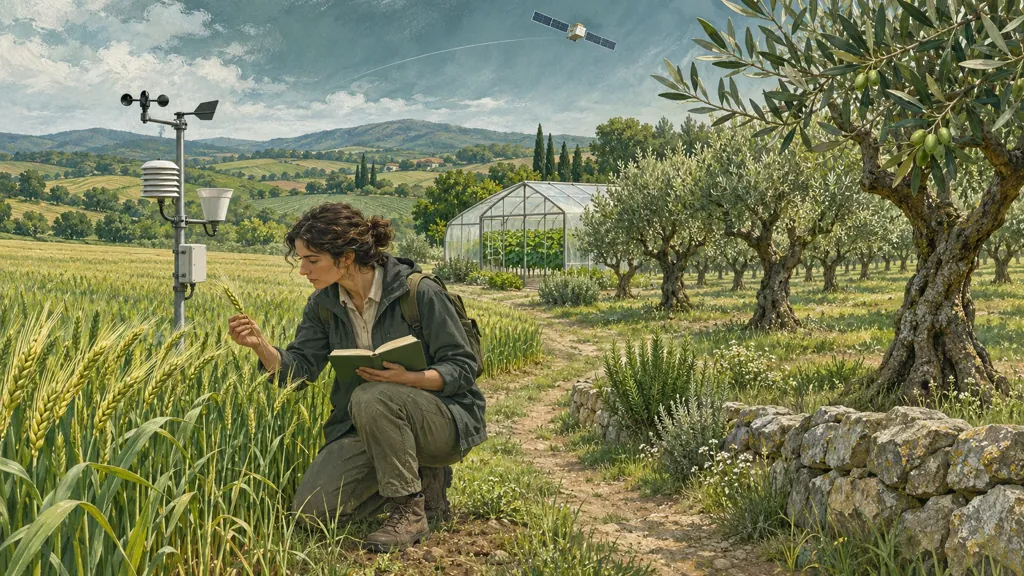
Emergence → tillering → stem elongation → heading/flowering → grain filling/maturity. Identify the species and observed staging system. Count stand and tillers with a stated area; record weather and lodging observations. Calendar days alone cannot identify a nutrient need or a spray window.
Olive
Bud development → flowering → fruit set → fruit growth → harvest. Record cultivar, tree age, canopy and crop load. Compare like phenological stages; inspect fruit and irrigation conditions. A photograph or a single harvest cannot establish alternate-bearing causes or nutrient response.
Citrus
Vegetative flush and flowering → petal fall/fruit set → fruit development → harvest. Flushes and fruit cohorts can overlap. Record species, rootstock, leaf age and sampling date, and inspect irrigation distribution. Do not use yellowing alone to identify deficiency or infectious disease.
Grapevine
Budbreak → shoot development → flowering/fruit set → veraison → harvest. Record cultivar, rootstock, intended market and sampling organ. Relate canopy and fruit observations to stage; distinguish berry maturity measurements from yield and disease interpretations.
Strawberry
Establishment → vegetative development → flowering → fruiting/harvest → postharvest. Day-neutral and seasonal systems differ; flowers and ripe fruit may coexist. Record cultivar, bed or substrate, drainage and repeated harvest batches. Inspect fruit condition without turning visual labels into diagnoses.
Banana
Vegetative pseudostem → inflorescence emergence → bunch development → harvest and ratoon succession. Record cultivar, mat/pseudostem identity and generation. Inspect drainage, cold and wind exposure and water quality. Florida home-landscape guidance does not establish tropical commercial fertilizer rates.
Orchard crops
Record the actual species: dormancy/bud development, bloom, fruit set/growth, harvest and postharvest where applicable. Phenology differs between evergreen and deciduous crops. Keep rootstock, tree age, crop load, frost observations and representative sampling zones separate; apple guidance is not a universal orchard protocol.
Greenhouse production
Record the crop’s actual stage alongside substrate, climate-sensor location, irrigation feed and drainage sampling points. Keep extraction methods and EC units explicit. Outdoor evapotranspiration, soil thresholds and greenhouse nutrient-solution readings are not interchangeable.
Precision agriculture
Follow acquisition → quality screening → spatial comparison → field inspection → reviewed decision. Preserve timestamps, product processing, cloud/shadow masks, valid coverage and field IDs. NDVI is a reflectance index, not a disease test, nutrient dose or independently calibrated yield forecast.
Calculation exercise
For the single-coefficient standard-condition example, ETc = Kc × ETo. Synthetic ETo = 4 mm/day and assumed Kc = 0.8 give 3.2 mm/day; this coefficient is not a crop recommendation. A root-zone balance also needs starting storage/depletion, rainfall, runoff, net irrigation, capillary contribution and deep drainage, with explicit signs and assumptions. Do not count runoff twice. One mm over one hectare equals 10 m³. Synthetic net depth 12 mm over 2 ha is 240 m³; with separately assumed efficiency 0.80, gross volume is 300 m³. At assumed measured system flow 30 m³/hour the arithmetic duration is 10 hours. These numbers are teaching inputs, not measured system performance. Validate actual area, flow, distribution, infiltration, drainage and safe operating limits before action. VWC (%) and matric potential (kPa) are different quantities; retain the device convention and soil-specific interpretation. Outdoor coefficients cannot be transferred unchanged to protected or substrate systems.
Sources and limits
No universal fertilizer, pesticide, irrigation, greenhouse climate or biostimulant prescription is provided. External recommendations are regional: UC guidance concerns California; UF/IFAS banana guidance concerns Florida home landscapes. Do not transfer their doses, pest thresholds or timings to another setting. Local diagnosis, product registration and application approval remain necessary. The source check on 2026-11-10 is an editorial check, not independent agronomist certification.
2026-11-10
- FAO Irrigation and Drainage Paper 56 (Allen et al., 1998)
- FAO 56, Chapter 6: single crop coefficient
- FAO 56, Chapter 8: soil water stress and root-zone balance
- University of Minnesota Extension: interpreting fruit and vegetable soil tests
- UC IPM: tomato fertilization
- UC IPM: irrigation of processing tomatoes
- Oklahoma State University: greenhouse media sampling and interpretation
- Oklahoma State University: understanding irrigation water test reports
- UC IPM: small-grain developmental growth stages
- UC IPM: tomato
- UC IPM: olive
- UC IPM: citrus
- UC IPM: grape
- UC IPM: strawberry
- UC IPM: apple
- UF/IFAS HS10: banana growing in the Florida home landscape
- NASA Earth Observatory: measuring vegetation (NDVI and EVI)
Related resources
- Irrigation: root-zone evidence and water-balance review
- Synthetic crop evidence chain: fields, analyses, tasks and harvest
- AgriDigi Hub
- Tomato
- Measurements and data quality
- Crop stages and inspection priorities
- Greenhouse production
Provenance and license
Original text, workflow and synthetic fixtures: AgriDigi, CC BY 4.0. Credit AgriDigi, link the source capsule and license, state changes and retain version provenance. External references retain their own terms and are not relicensed. Keep personal information, laboratory reports and precise farm locations private unless sharing is authorized. Generated illustrations are conceptual artwork, not observations, laboratory output or performance evidence.
https://creativecommons.org/licenses/by/4.0/
Action plan
Crop: Crop stages and inspection priorities · Duration: 14 days
Define the field and current stage
Day 0
Record field/planting identifiers, cultivar, system, actual growth stage and review question. Use the crop checklist below. Deliver a dated context card and identify missing evidence.
Check soil, water and observation methods
Day 1
Attach report references, sample methods and dates; verify units, sensor depth and quality flags. Keep actual measurements separate from estimates and missing data. Deliver an auditable evidence register.
Inspect crop and delivery conditions
Day 3
Use repeatable observation points and record counts with denominators. Review root-zone condition and irrigation delivery. Escalate unexplained symptoms; do not diagnose from a photo or index. Deliver observations and a review request.
Review the proposed decision
Day 7
Reconcile the locally approved nutrient or water plan with actual records. Check arithmetic and assumptions. Record approve, revise, defer or no intervention with a responsible reviewer; a task is not an application command.
Reconcile actual work and outcomes
Day 14
Keep planned and actual quantities distinct, link completed work and measured harvest records, and record unresolved gaps. Preserve source version and license. Deliver a review log and the next observation date, without causal performance claims.