Synthetic crop evidence chain: fields, analyses, tasks and harvest
Joinable synthetic teaching tables connect fields, soil reports, nutrient budgets, irrigation, tasks, harvest and references. Includes intentional missing and unmatched records; no real farm observations or direct farm imports.
License: cc-by-4.0
synthetic, soil-test, nutrient-budget, irrigation, harvest, csv, traceability
Overview
Synthetic crop evidence chain: fields, analyses, tasks and harvest
Scope and assumptions
This is an original educational workflow, not a field-validated production protocol. Its fourteen days are a review cycle, not crop-stage durations or a maturity forecast. Use the actual cultivar, production system, region and observed stage. Established measurement principles are distinguished from illustrative record design; all numerical exercises and supplied data are synthetic. No experimental efficacy or yield result is supplied.
The supplied tables are entirely invented schema exercises. Relate by exact field_id, planting_id, sample_id and source_id; validate cardinality before joining. Blank values are unknown, not zero. The orphan task and missing soil result are deliberate review cases. No polygon, private farm record, calibrated agronomic model or production import contract is supplied. Use the existing dataset explorer for supported single-file and pairwise joins; multi-table reconciliation is a reproducible offline exercise. Do not claim that a successful structural join validates nutrient sufficiency, disease diagnosis or a causal yield effect.
Measurements and data quality
Record identifiers, date/time with timezone, method, depth or spatial coverage, unit and quality flag. Keep measured observations, estimates, forecasts and synthetic records explicitly separate. A missing value stays blank/null; zero is a value and requires evidence. Preserve raw suspect readings and flag them. Compare like methods, units and growth stages. Soil-test concentrations are not fertilizer rates. Photographs and satellite indices guide inspection, not a definitive disease or nutrient diagnosis.
Calculation exercise
For the single-coefficient standard-condition example, ETc = Kc × ETo. Synthetic ETo = 4 mm/day and assumed Kc = 0.8 give 3.2 mm/day; this coefficient is not a crop recommendation. A root-zone balance also needs starting storage/depletion, rainfall, runoff, net irrigation, capillary contribution and deep drainage, with explicit signs and assumptions. Do not count runoff twice. One mm over one hectare equals 10 m³. Synthetic net depth 12 mm over 2 ha is 240 m³; with separately assumed efficiency 0.80, gross volume is 300 m³. At assumed measured system flow 30 m³/hour the arithmetic duration is 10 hours. These numbers are teaching inputs, not measured system performance. Validate actual area, flow, distribution, infiltration, drainage and safe operating limits before action. VWC (%) and matric potential (kPa) are different quantities; retain the device convention and soil-specific interpretation. Outdoor coefficients cannot be transferred unchanged to protected or substrate systems.
fields.csv / .json · soil.csv / .json · nutrients.csv / .json · irrigation.csv / .json · tasks.csv / .json · harvest.csv / .json · references.csv / .json
data-dictionary.json · expected-checks.json · validate.txt
python3 validate.txt
Greenhouse production
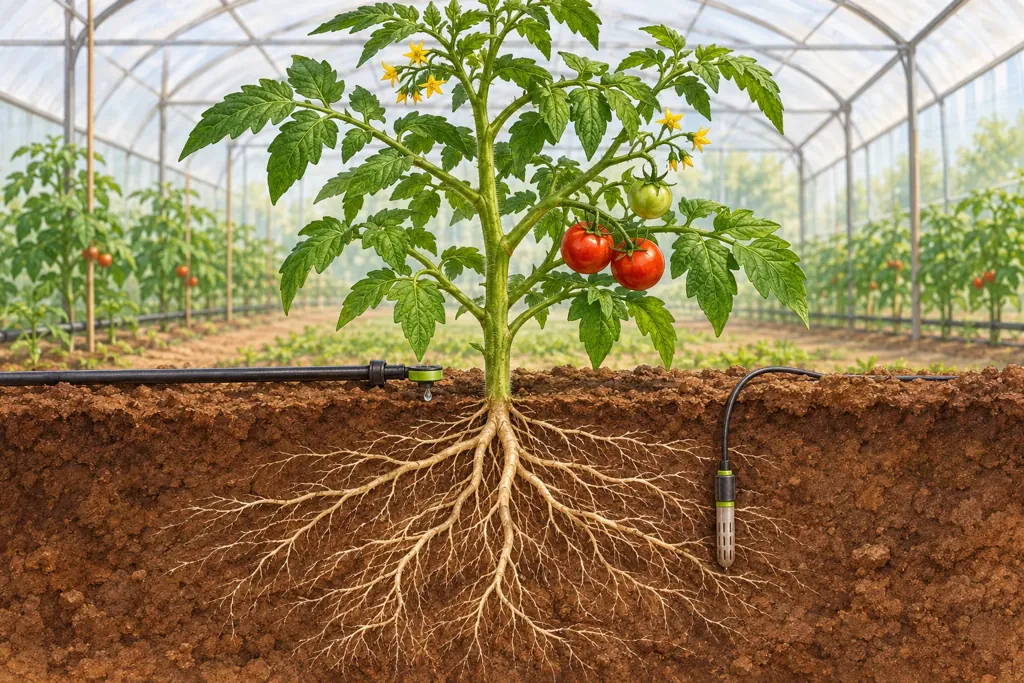
Record the crop’s actual stage alongside substrate, climate-sensor location, irrigation feed and drainage sampling points. Keep extraction methods and EC units explicit. Outdoor evapotranspiration, soil thresholds and greenhouse nutrient-solution readings are not interchangeable.
Precision agriculture
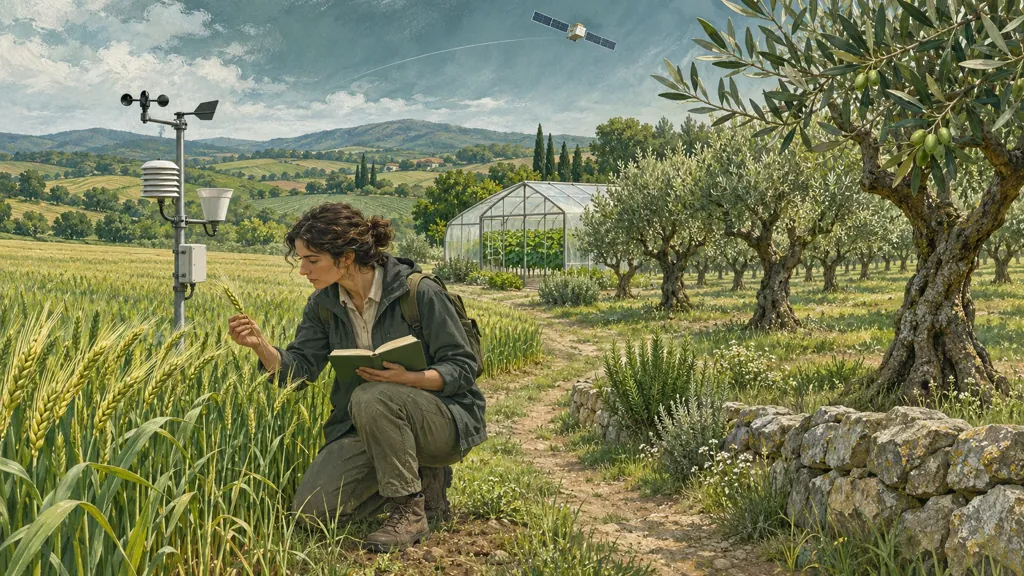
Follow acquisition → quality screening → spatial comparison → field inspection → reviewed decision. Preserve timestamps, product processing, cloud/shadow masks, valid coverage and field IDs. NDVI is a reflectance index, not a disease test, nutrient dose or independently calibrated yield forecast.
Sources and limits
No universal fertilizer, pesticide, irrigation, greenhouse climate or biostimulant prescription is provided. External recommendations are regional: UC guidance concerns California; UF/IFAS banana guidance concerns Florida home landscapes. Do not transfer their doses, pest thresholds or timings to another setting. Local diagnosis, product registration and application approval remain necessary. The source check on 2026-11-10 is an editorial check, not independent agronomist certification.
2026-11-10
- FAO Irrigation and Drainage Paper 56 (Allen et al., 1998)
- FAO 56, Chapter 6: single crop coefficient
- FAO 56, Chapter 8: soil water stress and root-zone balance
- University of Minnesota Extension: interpreting fruit and vegetable soil tests
- UC IPM: tomato fertilization
- UC IPM: irrigation of processing tomatoes
- Oklahoma State University: greenhouse media sampling and interpretation
- Oklahoma State University: understanding irrigation water test reports
- UC IPM: small-grain developmental growth stages
- UC IPM: tomato
- UC IPM: olive
- UC IPM: citrus
- UC IPM: grape
- UC IPM: strawberry
- UC IPM: apple
- UF/IFAS HS10: banana growing in the Florida home landscape
- NASA Earth Observatory: measuring vegetation (NDVI and EVI)
Related resources
- Crop stages: evidence review for cereals, fruit and protected crops
- Irrigation: root-zone evidence and water-balance review
- AgriDigi Hub
- Tomato
- Measurements and data quality
- Crop stages and inspection priorities
- Greenhouse production
Provenance and license
Original text, workflow and synthetic fixtures: AgriDigi, CC BY 4.0. Credit AgriDigi, link the source capsule and license, state changes and retain version provenance. External references retain their own terms and are not relicensed. Keep personal information, laboratory reports and precise farm locations private unless sharing is authorized. Generated illustrations are conceptual artwork, not observations, laboratory output or performance evidence.
https://creativecommons.org/licenses/by/4.0/
Dataset
Rows: 2
Columns: field_id, planting_id, crop, area_ha, system, observed_stage, is_synthetic, data_kind
- fields.csv · text/csv · 275 bytes
- fields.json · application/json · 493 bytes
- soil.csv · text/csv · 393 bytes
- soil.json · application/json · 668 bytes
- nutrients.csv · text/csv · 443 bytes
- nutrients.json · application/json · 830 bytes
- irrigation.csv · text/csv · 509 bytes
- irrigation.json · application/json · 918 bytes
- tasks.csv · text/csv · 490 bytes
- tasks.json · application/json · 917 bytes
- harvest.csv · text/csv · 424 bytes
- harvest.json · application/json · 728 bytes
- references.csv · text/csv · 4768 bytes
- references.json · application/json · 6507 bytes
- readme-en.txt · text/plain · 7707 bytes
- readme-tr.txt · text/plain · 7556 bytes
- readme-de.txt · text/plain · 7341 bytes
- readme-es.txt · text/plain · 7216 bytes
- readme-fr.txt · text/plain · 7329 bytes
- readme-it.txt · text/plain · 7042 bytes
- readme-az.txt · text/plain · 7350 bytes
- readme-ru.txt · text/plain · 9898 bytes
- readme-sr.txt · text/plain · 6862 bytes
- readme-ar.txt · text/plain · 8885 bytes
- data-dictionary.json · application/json · 45323 bytes
- expected-checks.json · application/json · 392 bytes
- validate.txt · text/plain · 2879 bytes
- license.txt · text/plain · 500 bytes
- tomato-root-zone-concept-v1.webp · image/webp · 173844 bytes
- crop-data-landscape-concept-v1.webp · image/webp · 173608 bytes