Irrigation: root-zone evidence and water-balance review
Connect sensor quality, weather estimates, root-zone water accounting and reviewed irrigation decisions. Includes synthetic unit calculations; no universal threshold or automatic control.
License: cc-by-4.0
irrigation, water-balance, soil-moisture, precision-agriculture, data-quality
Overview
Irrigation: root-zone evidence and water-balance review
Scope and assumptions
This is an original educational workflow, not a field-validated production protocol. Its fourteen days are a review cycle, not crop-stage durations or a maturity forecast. Use the actual cultivar, production system, region and observed stage. Established measurement principles are distinguished from illustrative record design; all numerical exercises and supplied data are synthetic. No experimental efficacy or yield result is supplied.
Adapt the plan privately, retain the source version and license, and replace example dates with locally appropriate review dates. Identify the field and planting, soil or substrate, irrigation system, weather source and responsible reviewer. Obtain the laboratory’s sampling instructions. Separate planned tasks from completed operations and do not create input quantities until an authorized local plan supplies them.
Measurements and data quality
Record identifiers, date/time with timezone, method, depth or spatial coverage, unit and quality flag. Keep measured observations, estimates, forecasts and synthetic records explicitly separate. A missing value stays blank/null; zero is a value and requires evidence. Preserve raw suspect readings and flag them. Compare like methods, units and growth stages. Soil-test concentrations are not fertilizer rates. Photographs and satellite indices guide inspection, not a definitive disease or nutrient diagnosis.
Editable review steps
0 · Define the field and current stage
Record field/planting identifiers, cultivar, system, actual growth stage and review question. Use the crop checklist below. Deliver a dated context card and identify missing evidence.
1 · Check soil, water and observation methods
Attach report references, sample methods and dates; verify units, sensor depth and quality flags. Keep actual measurements separate from estimates and missing data. Deliver an auditable evidence register.
3 · Inspect crop and delivery conditions
Use repeatable observation points and record counts with denominators. Review root-zone condition and irrigation delivery. Escalate unexplained symptoms; do not diagnose from a photo or index. Deliver observations and a review request.
7 · Review the proposed decision
Reconcile the locally approved nutrient or water plan with actual records. Check arithmetic and assumptions. Record approve, revise, defer or no intervention with a responsible reviewer; a task is not an application command.
14 · Reconcile actual work and outcomes
Keep planned and actual quantities distinct, link completed work and measured harvest records, and record unresolved gaps. Preserve source version and license. Deliver a review log and the next observation date, without causal performance claims.
Irrigation intelligence: from observations to a reviewed water balance
Irrigation scheduling begins with a question about a particular root zone, crop and time interval. It is not answered by a universal sensor percentage, a fixed weekly volume or a green satellite pixel. This editable fourteen-day review program organizes evidence, calculations and human decisions. Its dates describe a short review cycle; they do not specify watering frequency. Adapt the tasks to the crop stage and the farm’s approved operating procedure before creating calendar work.
Define the decision and its spatial support
Identify the field, planting, irrigated zone, production system and active rooting depth used in the assessment. Record whether the crop is rainfed, irrigated in soil, grown in substrate or managed with recirculating solution. Note the period being reviewed and the timezone. A weather station represents conditions at its location, a probe samples a small soil volume, and a field average can hide variation. Document the area and depth each observation represents.
Keep irrigation water quality and microbiological safety assessments separate from a water-quantity calculation. A correct volume does not establish that the water is suitable for a crop or intended use. Review laboratory and applicable local requirements through the farm’s existing process. State who approves a decision and where its supporting records will be kept.
Distinguish water content from water potential
Volumetric water content describes water volume per soil volume; a percentage and a fraction need an explicit scale. Matric potential describes how tightly water is held and may be reported using different sign or tension conventions. A kPa reading is not a percentage. Converting between them requires an appropriate soil-water relationship, rather than a fixed multiplier. Preserve the instrument’s convention and calibration information.
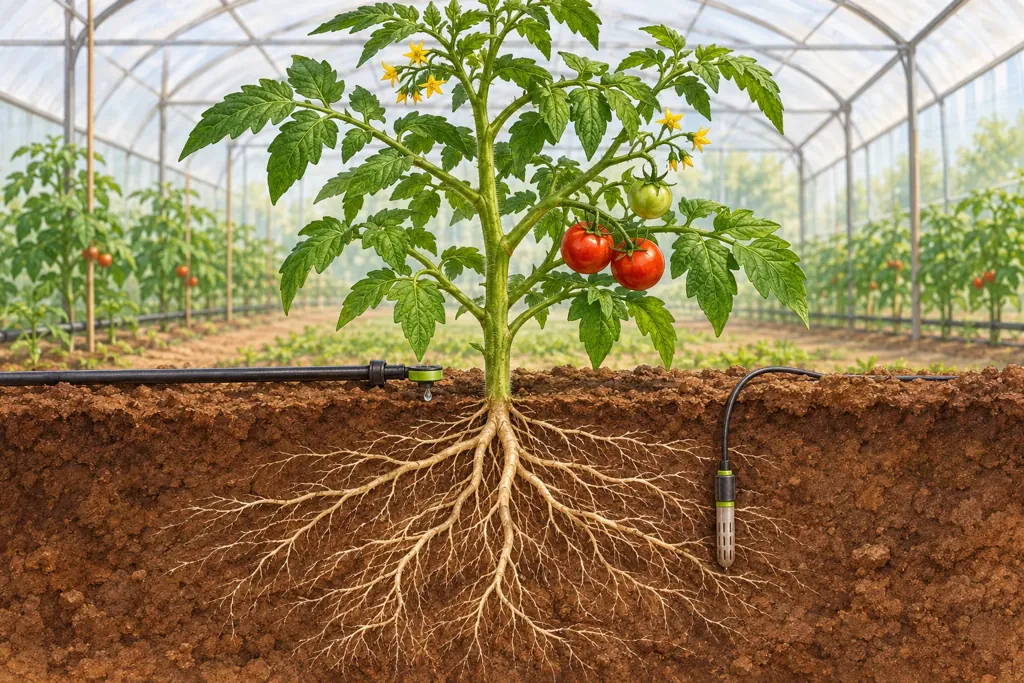
Record device identity, installation depth, date, timestamp, unit and quality flag. A missing observation remains null or blank, not zero. An implausible value should retain its raw value and a suspect flag while someone investigates it. Check contact with the soil, installation, power and calibration against the manufacturer’s instructions. Compare conditions at more than one relevant depth or location when the farm’s sampling plan calls for that comparison.
Treat evapotranspiration as an estimate
FAO’s reference framework separates reference evapotranspiration ETo from crop evapotranspiration ETc. In the single-coefficient approach under standard conditions, ETc = Kc × ETo. Select and document the coefficient’s crop, stage, climate and management assumptions. Keep a forecast based on predicted weather separate from an estimate based on observed weather. Neither becomes a measured field water loss merely because a formula produced it. FAO 56, Chapter 6.
For a synthetic arithmetic exercise only, ETo = 4 mm/day and an assumed Kc = 0.8 produce ETc = 3.2 mm/day. The coefficient is invented for the exercise and is not recommended for any crop. Field stress, salinity, canopy condition and management can invalidate standard-condition assumptions. Greenhouse and substrate systems need a method appropriate to their environment; an outdoor weather-station estimate should not be copied unchanged into a protected crop.
Record every water-balance term
A root-zone balance accounts for starting depletion, precipitation, runoff, irrigation entering the soil, capillary contribution, crop water use and deep drainage over the same interval. FAO Chapter 8 describes these terms and their signs. Do not silently set an unknown contribution to zero. Record whether each value was measured, estimated or deliberately assumed negligible, and explain the assumption. FAO 56, Chapter 8.
Using depletion as the accounting variable, a simplified bookkeeping expression is: ending depletion = starting depletion − precipitation + runoff − net irrigation − capillary rise + ETc + deep percolation. This expression is a record of terms, not an autonomous controller. Physical storage limits and uncertainty still need review. Avoid subtracting effective rainfall and then subtracting runoff again when runoff has already been excluded from that rainfall estimate.
Convert depth, volume and flow carefully
The geometric conversion is exact: 1 mm across 1 hectare is 10 m³. Thus a hypothetical net depth of 12 mm over 2 hectares corresponds to 240 m³. If a separately justified application efficiency is assumed to be 0.80, gross volume is 240/0.80 = 300 m³. These values illustrate arithmetic, not a recommended depth or efficiency. At an independently measured total system flow of 30 m³/hour, the corresponding arithmetic duration is 10 hours.
Before using a duration operationally, confirm the actual wetted area, simultaneous zones, flow unit, pressure and safe operating limits. Distinguish whole-system flow from one emitter’s flow. A conversion does not establish distribution uniformity, infiltration capacity or adequate drainage. Record the applied meter volume after work; a planned runtime is not a measured irrigation amount. Large uncertainty should be visible in the decision record rather than hidden behind extra decimal places.
Inspect delivery and root-zone response
Compare delivery observations with the approved system inspection procedure. Record leaks, blocked emitters, pressure differences and inaccessible measurement points. After any approved irrigation, compare the available root-zone observations with the anticipated response and retain the timestamp. Unexpected behavior can indicate a measurement or delivery problem; it does not automatically justify more water.
Water analysis needs its own sampling method and unit context. Electrical conductivity summarizes ionic conductivity; it does not report the identity or concentration of each nutrient. Sodium hazard and other constituents require additional interpretation. Keep source-water results distinct from soil, media and drainage extracts. OSU irrigation-water reports and greenhouse media testing provide context rather than universal targets.
Use satellite observations to select checks
NDVI uses near-infrared and red reflectance in the expression (NIR − red)/(NIR + red), with the appropriate product’s scaling, masks and processing. Record acquisition time, product identity, cloud and shadow screening, spatial resolution and valid coverage. When the denominator is zero or a pixel is invalid, retain an invalid or missing value rather than manufacturing an index. NASA vegetation indices.
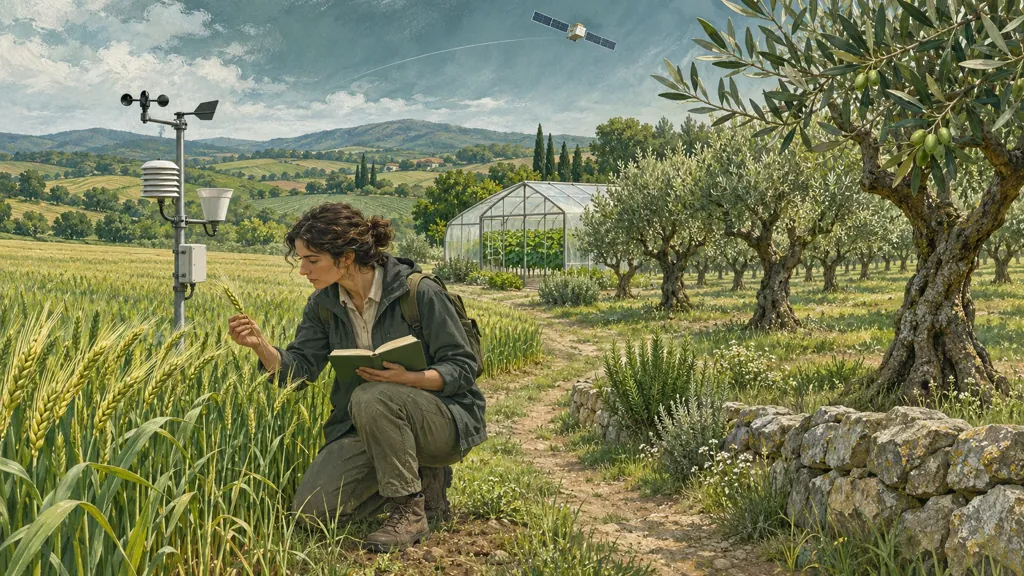
A change in an index can guide where to inspect. It cannot uniquely identify water stress, nitrogen deficiency, disease or a yield outcome. Compare suitable acquisitions and investigate field boundaries, mixed pixels, bare soil and canopy changes before assigning an explanation. A generated illustration is conceptual artwork and must never appear as an acquired satellite product or evidence of an intervention’s success.
Close the review with a reproducible decision
For each review, keep the source observations, quality exclusions, assumptions, calculation version, proposed action, decision and approver reference. “Inspect the device,” “defer pending evidence” and “no irrigation required” are valid outcomes. A calendar task schedules work and does not operate a valve. Use existing authorized controls for any real intervention. Preserve planned and actual records separately so a later review can explain the difference.
Evaluate outcomes using measured volume, defined crop observations and any recorded harvest data. A change in water use or yield alone does not establish causation or water savings. A research comparison needs equivalent boundaries, periods, measurement methods and a design suited to the question. This program supplies no field experiment, calibrated forecast model, diagnosis or promised improvement. Its original workflow and synthetic arithmetic are educational; actual thresholds, coefficients and applications require local validation.
Sources and limits
No universal fertilizer, pesticide, irrigation, greenhouse climate or biostimulant prescription is provided. External recommendations are regional: UC guidance concerns California; UF/IFAS banana guidance concerns Florida home landscapes. Do not transfer their doses, pest thresholds or timings to another setting. Local diagnosis, product registration and application approval remain necessary. The source check on 2026-11-10 is an editorial check, not independent agronomist certification.
2026-11-10
- FAO Irrigation and Drainage Paper 56 (Allen et al., 1998)
- FAO 56, Chapter 6: single crop coefficient
- FAO 56, Chapter 8: soil water stress and root-zone balance
- University of Minnesota Extension: interpreting fruit and vegetable soil tests
- UC IPM: tomato fertilization
- UC IPM: irrigation of processing tomatoes
- Oklahoma State University: greenhouse media sampling and interpretation
- Oklahoma State University: understanding irrigation water test reports
- UC IPM: small-grain developmental growth stages
- UC IPM: tomato
- UC IPM: olive
- UC IPM: citrus
- UC IPM: grape
- UC IPM: strawberry
- UC IPM: apple
- UF/IFAS HS10: banana growing in the Florida home landscape
- NASA Earth Observatory: measuring vegetation (NDVI and EVI)
Related resources
- Crop stages: evidence review for cereals, fruit and protected crops
- Synthetic crop evidence chain: fields, analyses, tasks and harvest
- AgriDigi Hub
- Tomato
- Measurements and data quality
- Crop stages and inspection priorities
- Greenhouse production
Provenance and license
Original text, workflow and synthetic fixtures: AgriDigi, CC BY 4.0. Credit AgriDigi, link the source capsule and license, state changes and retain version provenance. External references retain their own terms and are not relicensed. Keep personal information, laboratory reports and precise farm locations private unless sharing is authorized. Generated illustrations are conceptual artwork, not observations, laboratory output or performance evidence.
https://creativecommons.org/licenses/by/4.0/
Action plan
Crop: Crop stages and inspection priorities · Duration: 14 days
Define the field and current stage
Day 0
Record field/planting identifiers, cultivar, system, actual growth stage and review question. Use the crop checklist below. Deliver a dated context card and identify missing evidence.
Check soil, water and observation methods
Day 1
Attach report references, sample methods and dates; verify units, sensor depth and quality flags. Keep actual measurements separate from estimates and missing data. Deliver an auditable evidence register.
Inspect crop and delivery conditions
Day 3
Use repeatable observation points and record counts with denominators. Review root-zone condition and irrigation delivery. Escalate unexplained symptoms; do not diagnose from a photo or index. Deliver observations and a review request.
Review the proposed decision
Day 7
Reconcile the locally approved nutrient or water plan with actual records. Check arithmetic and assumptions. Record approve, revise, defer or no intervention with a responsible reviewer; a task is not an application command.
Reconcile actual work and outcomes
Day 14
Keep planned and actual quantities distinct, link completed work and measured harvest records, and record unresolved gaps. Preserve source version and license. Deliver a review log and the next observation date, without causal performance claims.