Citrus irrigation water and salinity review
Compare irrigation water, root-zone salinity and comparable citrus leaf samples before a local decision.
License: cc-by-4.0
citrus, orchard, irrigation, salinity, water-quality, leaf-sampling
Overview
An adaptable evidence review for citrus grown in soil. Record scion, rootstock, water source and observed development. The days organize the review. Use the local sampling and interpretation method.
AI-generated illustration of a scout beside a drip line in a citrus orchard
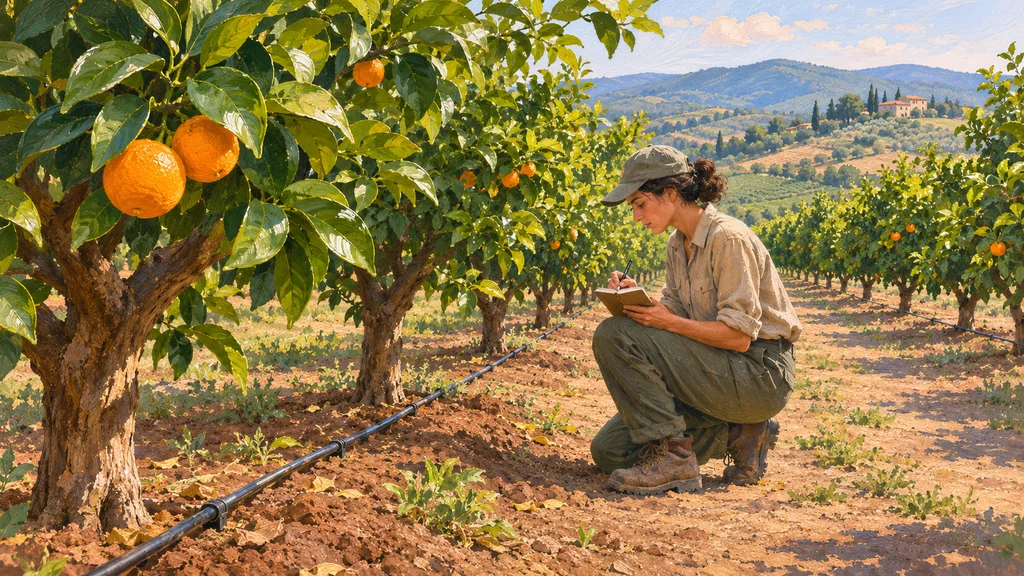
Review irrigation water, soil salinity and leaf evidence in citrus
This companion supports an evidence review for citrus orchards in soil. Start with the scion, rootstock, age class, irrigation source and method, management block and observed crop stage. Keep production purpose and any known differences in soil texture or drainage. A block that receives a different water source or contains a different rootstock needs an identifiable record. The capsule days organize a review of observations and laboratory reports. They do not set sampling windows, irrigation amounts or treatment dates.
Match the samples to a question
State whether the question concerns the source water, delivered water, root-zone conditions, tissue composition or a symptom. Record water source, sampling point, timestamp, operating state and any blending or fertigation. If the source is sampled upstream of injection and a second sample is taken within the irrigation system, retain both points and their conditions. A water sample describes the sampled condition. A changing well, a temporary blend or an injection event can make a different sample inappropriate for comparison. Follow the laboratory’s container, collection and handling procedure for the requested analyses. Irrigation-water evaluation
For soil, record position relative to the tree and emitter, sampled depth, crop stage and recent water inputs. In drip irrigation, different positions around a wetted zone can have different salt patterns. A repeated comparison requires a documented sampling position or design. Separate routine samples from targeted checks of problem areas. Identify the extract method on the laboratory report. Soil ECe refers to electrical conductivity of the saturated-paste extract. A fixed-ratio soil-water extract or a field probe has its own measurement basis. Use the laboratory’s calibrated method and interpretation for each. Soil salinity measurement and symptom assessment
Check conductivity and sodium adsorption ratio
ECw is the electrical conductivity of the water. Read the unit and the measurement or reference temperature before comparison. Conductivity indicates the overall ability of the solution to carry electric current. It does not provide the concentration of chloride, sodium or boron individually. Those require their own analyses. A water ECw and a soil ECe can share a unit while representing different samples and different physical conditions. Keep the sample identity with the result. Water test units and analytes
The next table contains entirely invented water-report values. The conductivity has already been stated at a reference temperature of 25 °C. A unit conversion gives 1.2 dS/m = 1.2 mS/cm = 1200 µS/cm. The same sample and reference temperature apply to all three expressions.
| Fictional report field | Basis | Value |
|---|---|---|
| ECw | dS/m at 25 °C | 1.2 |
| Sodium | meq/L | 6 |
| Calcium | meq/L | 4 |
| Magnesium | meq/L | 2 |
The conventional sodium adsorption ratio uses sodium divided by the square root of half the sum of calcium and magnesium. Use the ions as charge concentrations in meq/L, numerically equivalent to millimoles of charge per litre. If the report gives mg/L, use validated equivalent-weight conversions or the laboratory’s calculated result before applying this expression. For the invented table, SAR = 6 / √((4 + 2) / 2) ≈ 3.46. The calculated index describes the specified water composition under that convention. It cannot determine the exchangeable sodium status of the soil or tell how much an orchard should irrigate. Infiltration assessment considers ECw and SAR together with measured soil properties and field evidence. FAO infiltration framework
Keep leaf samples comparable
Record the leaf cohort and age, fruiting status of the shoot, position in the canopy, scion, rootstock, sampling date and analytical basis. Map the leaf sample to the relevant block and trees. Keep a routine nutrition sample separate from a targeted diagnosis sample. If comparing affected and less affected trees, use a comparable cohort and production context and retain distinct sample identifiers. Recent foliar sprays, dust and surface residues can bias the result for some elements. Record them and follow the laboratory’s instructions for sampling and preparation. A visual contrast or satellite signal can help select inspection points. Field examination and laboratory evidence support interpretation.
Use the timing and tissue protocol that belong to the local interpretation method. The Florida extension guide illustrates standardized sampling of comparable spring-flush leaves. Türkiye’s Alata guidance describes soil and leaf analysis within its regional orchard context. Calendar months, tree counts, sampling depths and interpretation ranges in these sources belong to their own protocols. Florida soil and leaf sampling · Alata citrus guidance
Interpret the orchard observations together
Record the actual flush, flowering, fruit set or fruit enlargement stage and any overlapping cohorts. Separate fruit or leaf observations from dates predicted by a calendar. Salts can reduce the ease with which roots take up water. Some ions can also accumulate in tissue and contribute to injury. Rootstock and scion, soil conditions, water delivery and exposure can change what the orchard experiences. A grapefruit field experiment across several rootstocks found interactions among rootstock, salinity and nutrition under its study conditions. Its results do not provide an orchard-wide ranking, dose or threshold for a different site. Grapefruit rootstock field study
Leaf edge injury, yellowing and weak growth have overlapping causes. Check emitter delivery, soil moisture and drainage, recent fertilizer or spray records, root condition and symptom distribution. Test for appropriate causes rather than assigning a diagnosis from a single leaf measurement, image or EC value. Trace the source water and sampling history when results disagree. Keep missing results explicit. An assumed zero would incorrectly suggest that the analyte had been measured. If a follow-up comparison uses a new laboratory or method, record the change.
Record the next decision and its evidence
Link water, soil and tissue results to the block, observed stage, method and review date. Record what was measured, what was calculated, the reviewer and the next observation or professional evaluation. If the team approves a change through the existing process, record the planned and actual event separately. Use comparable methods for follow-up observations and check for changes in water source, sampling location, rainfall and irrigation delivery. Harvest quality or output can be recorded separately with its basis and coverage. An uncontrolled difference does not establish the effect of a change.
All worked-example inputs and results are synthetic. The capsule supports documentation and review. Real water, soil, nutrient or irrigation decisions require an applicable local method and field evidence.
Review tasks
0 · Define the orchard block
Record scion, rootstock, age class, observed stage and irrigation source. Separate areas with different water or soil conditions.
1 · Match water and soil samples
Record source and delivery sampling points, any blending or injection, soil depth and emitter position. Keep water ECw distinct from saturated-paste extract ECe.
3 · Check the laboratory units
Confirm conductivity units and reference temperature. Review the charge-concentration units used to calculate sodium adsorption ratio. Keep individual ions and missing values visible.
7 · Review comparable leaf samples
Record leaf cohort, age, fruiting status, spray history and analytical basis. Keep routine samples and targeted diagnosis separate.
14 · Record the decision and next check
Compare delivery, drainage and field evidence. Save sample identifiers, the reviewer and the next observation. Keep planned and actual events distinct.
All worked-example inputs and results are synthetic. Actual decisions require a locally applicable method and field evidence.
Scientific sources
- FAO · Ayers & Westcot, Water Quality for Agriculture, irrigation-water evaluation
- FAO · Water Quality for Agriculture, infiltration problems
- Oklahoma State University Extension · Understanding Your Irrigation Water Test Report
- UC Statewide IPM Program · Nutrient and Mineral Excesses, Salinity, and Salt Toxicity
- University of Florida IFAS Extension · Soil and Leaf Tissue Testing for Commercial Citrus Production, SS531
- Levy & Lifshitz (2000) · The response of orchard citrus trees on different rootstocks to irrigation with saline water, Acta Horticulturae 537:629–640
- Onur Uysal (2022) · Alata Bahçe Kültürleri Araştırma Enstitüsü, Turunçgil Yetiştiriciliği
Related AgriDigi capsules
- Crop-stage evidence
- Irrigation monitoring
- Soil sampling and interpretation
- Field scouting
- Synthetic crop records
Original AgriDigi text and tasks are licensed under CC BY 4.0. Attribute AgriDigi and identify adaptations. Linked sources retain their own terms.
https://creativecommons.org/licenses/by/4.0/
Action plan
Crop: Citrus · Duration: 14 days
Define the orchard block
Day 0
Record scion, rootstock, age class, observed stage and irrigation source. Separate areas with different water or soil conditions.
Match water and soil samples
Day 1
Record source and delivery sampling points, any blending or injection, soil depth and emitter position. Keep water ECw distinct from saturated-paste extract ECe.
Check the laboratory units
Day 3
Confirm conductivity units and reference temperature. Review the charge-concentration units used to calculate sodium adsorption ratio. Keep individual ions and missing values visible.
Review comparable leaf samples
Day 7
Record leaf cohort, age, fruiting status, spray history and analytical basis. Keep routine samples and targeted diagnosis separate.
Record the decision and next check
Day 14
Compare delivery, drainage and field evidence. Save sample identifiers, the reviewer and the next observation. Keep planned and actual events distinct.