Olive flowering, alternate bearing and harvest review
Follow tagged shoots, compare crop load across seasons and reconcile harvest and mill records for olives.
License: cc-by-4.0
olive, orchard, phenology, scouting, alternate-bearing, harvest
Overview
An adaptable review for table or oil olives. Record block, cultivar, water regime and intended use. The days organize the review and do not set biological stages or a harvest date.
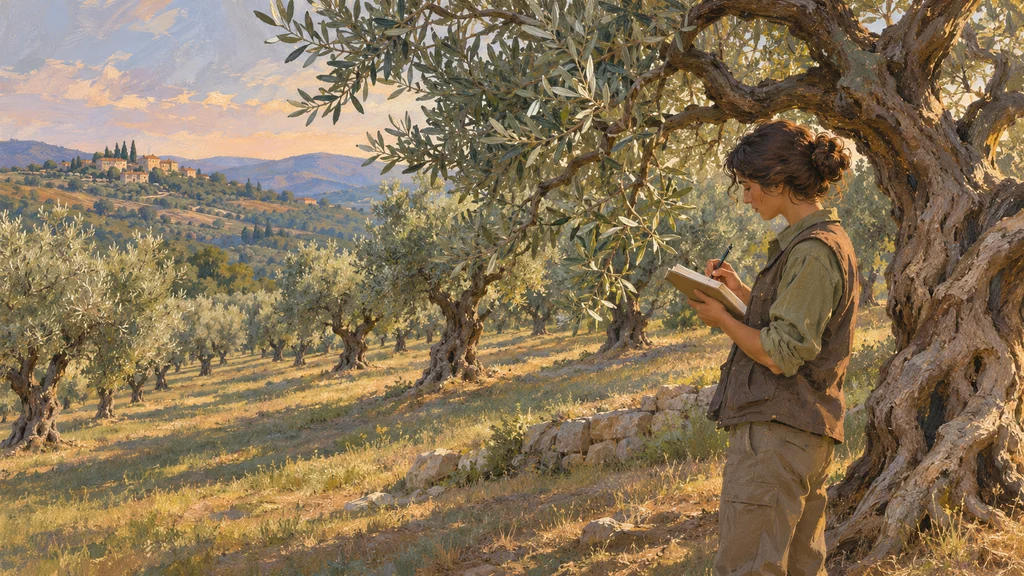
AI-generated illustration of a scout taking notes in an olive orchard
Olive flowering, crop load and harvest records
This companion helps an orchard manager follow olive phenology and maintain comparable records from flowering to harvest and into the following season. It covers olives grown for oil or table use. The downstream lot records differ with the destination. Set the block, cultivar, age class, production system and use before observing. Keep rainfed and irrigated observations identifiable. The capsule days organize a short review cycle. Field visits occur when the relevant stage can be observed or when a previous record is available for review.
Identify the block and the sampling units
Record the orchard block, cultivar, planting system, water regime and production purpose. Keep cultivar changes, young replants and consistently different soil or water zones visible in the record. Select a sampling design that represents the population you intend to describe. Tag the trees and shoots to be revisited. Document how they were selected and the canopy positions represented. Record shoot age or cohort, aspect and height when these affect comparisons. A branch visited because it looked unusual belongs to a targeted check. A block-level summary requires a design that supports inference to that block.
Record the observation date and stage reference. The olive-specific BBCH scale covers bud, shoot, inflorescence, flowering, fruit development and ripening stages. For example, its BBCH 65 marker identifies full flowering when at least half the flowers are open under the cited protocol. State which unit you assessed and report a distribution or observed range where branches or cultivars differ. Check early fruit development, stone hardening and colour change at the appropriate visits. A calendar from another cultivar or region is context for scheduling observations. The actual stage comes from the plants you observe. Olive BBCH scale · Field descriptions from IVIA · Turkish cultivar observations
Revisit the same cohort after flowering
Decide whether you will count individual flowers, inflorescences, fruit or bearing shoots. Record the denominator and the visit stage. For the exercise below, one marked shoot on each of three fictional trees has a count of inflorescences at flowering. At a defined follow-up visit, the observer counts fruit on the same intact shoots. New shoots, lost tags and branches removed between visits need their own record. If the matched cohort changes, specify the subset used in the comparison and report the excluded units. A completed inspection with no fruit is an observed zero. An unobserved shoot remains missing.
| Fictional shoot | Inflorescences at flowering | Fruit at follow-up |
|---|---|---|
| S1 | 8 | 6 |
| S2 | 7 | 5 |
| S3 | 9 | 7 |
The invented sample has 24 inflorescences and 18 fruit at follow-up, giving 18 / 24 = 0.75 fruit per previously counted inflorescence. The number describes a paired count at that visit. A flower-level fruit-set fraction would require counting the relevant individual flowers and following that denominator under a defined protocol. Preserve the follow-up date because subsequent fruit drop can change the count. Record suspected weather, pollination, water or injury factors separately from the count. Comparative measurements or an appropriate diagnostic process are needed before a cause is assigned.
Compare crop load and return bloom across seasons
Olive inflorescences commonly develop from buds on shoots formed in the previous growing season. The current fruit load and vegetative shoot growth can influence the supply of flowering sites and the next season’s return bloom. Some olive cultivars show alternating heavy and light crops. The strength of the pattern can differ between trees, years, cultivars and management conditions. Fruit removal research in Coratina and California research on table olives give context for the biology. Their treatment timing and outcomes belong to those studies. Crop-load experiment · University of California olive research
Keep consecutive seasons under the same block and tree identifiers where feasible. Compare flower observations at comparable stages, record the shoot cohort and keep the pruning date, weather, irrigation and crop damage alongside the record. Keep fruit harvested per tree distinct from fruit harvested per area. State which trees or area were included and which parts of the harvest are missing. Two opposite crop years can suggest a question about alternate bearing. Further consistent records help characterize whether the pattern repeats. Weather, incomplete picking or changing measurement methods can also shift recorded output. The observed pattern alone cannot isolate the effect of a management intervention.
Assess readiness for the intended market
For table olives, record the market or processor’s intended fruit style and the associated sample method, fruit size, condition and defects. For oil olives, take a representative sample for maturity, damage and any appropriate laboratory measurements. Keep the sampling date, cultivar mix, canopy positions and colour-class protocol. A colour-based maturity index summarizes the sample’s colour classes. Fruit condition, intended style, the time and handling between picking and processing, and the mill’s operating plan matter to the decision. Oil quality and legal grade require the applicable assessments. The maturity index and this capsule do not assign those outcomes. International Olive Council oil-olive methods
Reconcile the harvest and mill records
Assign a lot identifier before harvest. Retain block, cultivar or documented blend, harvest date and net fruit mass, with tare subtracted where applicable. Record weigh point and distinguish orchard dispatch from mill receipt. For oil lots, link the mill receipt, processing batch, fruit mass and credited oil mass, and state whether a lot was processed separately or pooled. When lots are pooled, use a documented allocation if one exists and mark the output as allocated. A missing allocation leaves a lot-specific result unresolved. Keep weights and volumes separate. Any conversion between litres and kilograms needs an explicit, appropriate density and conditions.
In a separate synthetic oil lot, 240 kg of net fruit received at the mill is matched to 36 kg of oil credited to that lot. The mass ratio is 36 / 240 × 100 = 15%. It describes the chosen lot boundary and is independent of the tagged-shoot example. Laboratory total oil content uses a specified test and may be reported on a fresh- or dry-matter basis. Record the basis and moisture measurement when comparing laboratory results. The mill receipt ratio depends on the lot and processing boundary. It supplies neither a laboratory oil content nor a quality grade. A before-and-after comparison needs comparable inputs, processing and sampling to support further interpretation.
Close the review with an auditable decision
Save the orchard, stage, sample, harvest and mill identifiers with the responsible reviewer and the next check. Link water or soil evidence where it explains the context. Keep observations, calculated ratios, allocations and unverified explanations distinct. Record the actual event separately from any planned date. Preserve the capsule version and attribution when adapting the workflow.
All worked-example inputs and results are synthetic. Local advice and the processor’s evidence determine actual harvest decisions, irrigation or other interventions. This original AgriDigi companion provides a way to document those decisions and their evidence.
Review tasks
0 · Define the orchard block
Record cultivar, tree age or cohort, production system, water regime and intended use. Define the trees and shoots represented by the observations.
1 · Observe flowering and revisit shoots
Record the olive BBCH stage, denominator and visit date. Revisit the same tagged shoots to count fruit. Mark missing tags and confirmed zeros separately.
3 · Compare crop load and return bloom
Record the same trees across seasons at comparable stages. Keep crop load, pruning, shoot growth, weather and incomplete harvests visible.
7 · Review market readiness
Record the market, sample method and fruit condition. For oil olives, preserve the maturity protocol and analytical basis.
14 · Reconcile the lot records
Match harvest and mill receipts, fruit net mass and credited oil mass. Flag pooled or allocated output and keep quality assessment separate.
All worked-example inputs and results are synthetic. Actual decisions require locally appropriate evidence.
Scientific sources
- Sanz-Cortés et al. (2002) · Phenological growth stages of olive trees, Annals of Applied Biology 140:151–157
- IVIA · Identificación de los estados fenológicos del crecimiento en olivo
- Dag et al. (2010) · Timing of fruit removal affects concurrent vegetative growth and subsequent return bloom and yield in olive, Scientia Horticulturae 123:469–472
- University of California · Lindcove Research and Extension Center olive research
- International Olive Council · Guide for the determination of the characteristics of oil-olives, COI/OH/Doc. No 1
- Dölek & Özkaya (2024) · Phenological Growth Stages of Some Olive Cultivars, Çukurova Journal of Agricultural and Food Sciences 39:13–24
Related AgriDigi capsules
- Crop-stage evidence
- Field scouting
- Irrigation monitoring
- Soil sampling and interpretation
- Synthetic crop records
Original AgriDigi text and tasks are licensed under CC BY 4.0. Attribute AgriDigi and identify adaptations. Linked sources retain their own terms.
https://creativecommons.org/licenses/by/4.0/
Action plan
Crop: Olive · Duration: 14 days
Define the orchard block
Day 0
Record cultivar, tree age or cohort, production system, water regime and intended use. Define the trees and shoots represented by the observations.
Observe flowering and revisit shoots
Day 1
Record the olive BBCH stage, denominator and visit date. Revisit the same tagged shoots to count fruit. Mark missing tags and confirmed zeros separately.
Compare crop load and return bloom
Day 3
Record the same trees across seasons at comparable stages. Keep crop load, pruning, shoot growth, weather and incomplete harvests visible.
Review market readiness
Day 7
Record the market, sample method and fruit condition. For oil olives, preserve the maturity protocol and analytical basis.
Reconcile the lot records
Day 14
Match harvest and mill receipts, fruit net mass and credited oil mass. Flag pooled or allocated output and keep quality assessment separate.