Wheat growth stages and nitrogen review
Stage wheat from field observations, check stand counts and review soil and nitrogen records before a local decision.
License: cc-by-4.0
wheat, crop-stages, scouting, soil-test, nitrogen, nutrient-budget
Overview
An adaptable evidence review for grain wheat in mineral soil. Record whether the crop is winter or spring wheat and rainfed or irrigated. The days are example review dates.
AI-generated illustration of a scout examining leaves in a wheat field
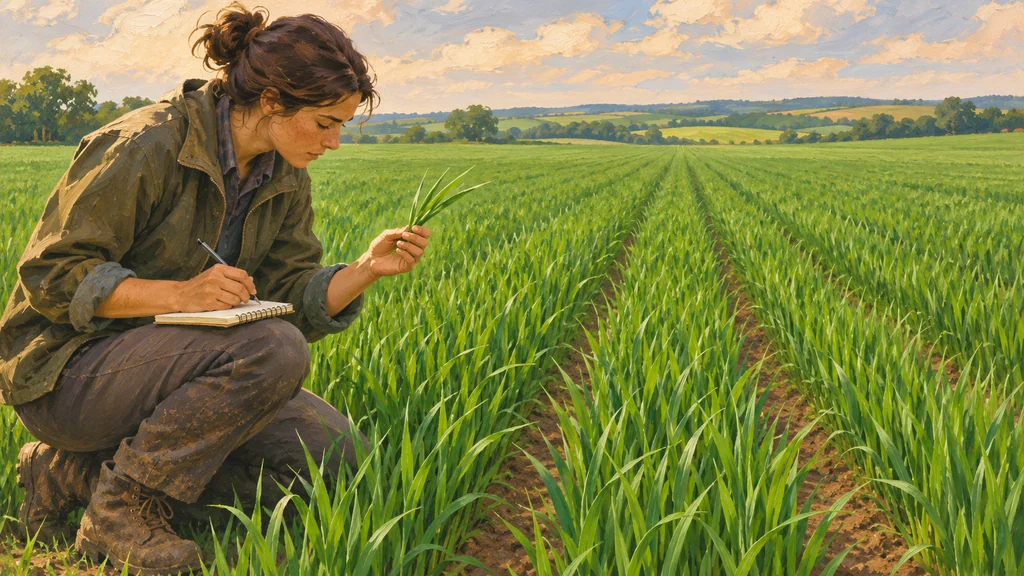
Field staging and nitrogen review for wheat
Use this guide to record the development of a wheat crop and review the evidence behind a nitrogen decision. It applies to wheat grown for grain in mineral soil. The field steps can be adapted to winter or spring wheat by the responsible reviewer. Confirm cultivar, crop class, sowing date, rainfed or irrigated status, market and locally applicable recommendation method. The capsule days organize the review. Observed plant development determines the stage.
Identify the stage from the plant
Record the scale with the code. The original Zadoks decimal scale provides the provenance for the Z codes used here. BBCH-based references describe closely related field markers. Follow the definitions of the chosen reference, especially where protocols differ. Leaf development and tillering can overlap. Record the leaves on the main shoot separately from side shoots. For example, Z21 describes a main shoot with one tiller. A field can include plants and shoots at different stages. Keep counts by stage or report the observed range and sampling method, with enough detail for a later reviewer to interpret it. Zadoks scale provenance · Spring wheat development
At the transition to stem elongation, inspect representative main shoots. Use a longitudinal cut if the node is difficult to see, with a safe tool procedure and permission to remove the plant. For first-node assessment, the AHDB BBCH method checks that the first detectable node is above an internode at least 1 cm long. Follow the chosen reference and keep the observation separate from any calendar forecast. Near the end of stem elongation, distinguish flag leaf just visible from flag leaf unfolded with its ligule visible. Record booting, heading, flowering and grain development separately. A half-emerged head is a heading marker. Visible anthers help identify flowering. Scales and assessment conventions belong in the observation record. Practical cereal stage markers
Count plants and shoots with the right denominator
Choose a sampling plan for the management zone and record the area or row length represented by each count. Avoid using a headland, bare patch or satellite anomaly as the sole sample for a zone-wide estimate. Keep targeted visits to such sites separate. Count established plants and define which live shoots are counted separately. A shoot density uses the specified main shoots and tillers. An emerged plant density counts plants. When converting a sampled row length to ground area, record the representative row spacing and number of rows. Retain the raw counts, locations, excluded quadrats and coverage limits. Field stand assessment
The following numbers are invented. For five non-overlapping, equal-area quadrats in a fictional zone, each area is 0.25 m².
| Fictional quadrat | Sample area (m²) | Plants |
|---|---|---|
| Q1 | 0.25 | 42 |
| Q2 | 0.25 | 46 |
| Q3 | 0.25 | 49 |
| Q4 | 0.25 | 44 |
| Q5 | 0.25 | 49 |
The total is 230 plants and the total area is 1.25 m². The sample density is 230 / 1.25 = 184 plants/m². The sample says nothing about an appropriate stand target or yield. A zone-wide estimate requires a representative design. If a quadrat cannot be assessed, keep a missing reason. A checked quadrat with no established plants counts as zero. Keep shoot counts distinct when the next review compares tiller survival or head density.
Interpret development with roots, water and crop condition
The crop forms leaves and side shoots before and during canopy development. The development of fertile shoots and florets influences grain number, while grain filling adds dry matter to kernels. The same visible stage can occur on different dates depending on cultivar, temperature, day length and vernalization. Use the actual stage for the crop class and local context. The likelihood of a response to nitrogen also depends on rooting, soil water, other nutrients and disease or injury. Inspect symptoms and compare roots, stand and management history before drawing a conclusion from colour or a vegetation index. Waterlogged or dry areas can produce misleading visual comparisons. FAO wheat physiology
When assessing a later input, record lodging risk, expected remaining growing conditions, current crop value or quality objectives, and any local operating constraints. A crop managed for grain protein may have a different economic response from one managed for grain mass. A forecast, soil observation and input recommendation should have separate records with their own assumptions. The cited North Dakota spring wheat and durum method and Turkish regional extension material give examples of region-specific guidance. Keep their units and context if consulting them. Transfer of a rate, soil depth, credit or split schedule requires local validation. North Dakota spring wheat and durum guidance · Turkish regional guidance
Audit the nitrogen budget before deciding
Start with an identified regional method appropriate for the class, water regime and production conditions. Write down what its starting value means and which credits it already incorporates. A laboratory result should retain sample date, zone, sampled depths, analyte and units. A nitrate concentration reported as nitrate-N in mg/kg has a different meaning from a soil stock in kg N/ha or a result reported as nitrate ion. Use the applicable method for any interpretation or conversion. A soil stock and the nitrogen that a local recommendation allows as a credit can differ. Keep previous crop, manure and earlier fertilizer entries with dates and the rule authorizing any credit. Count each credit once. Keep estimates and unverified entries visible for review.
In a separate fictional ledger, the starting planning value is 40 kg N/ha and excludes the following three entries. The invented method treats 9 kg N/ha as an eligible soil credit, 6 kg N/ha as an eligible previous-crop credit and 5 kg N/ha as an eligible prior-application credit. The arithmetic is 40 - 9 - 6 - 5 = 20 kg N/ha. These values are synthetic. The result illustrates bookkeeping for a particular definition of the starting value. Some regional methods already include one or more of these items. A double subtraction would make the ledger inconsistent. Fertilizer product mass uses the label fraction and treated area only after an authorized nutrient rate and source have been independently approved.
Close the review with a traceable record
Link the zone, crop cycle, stage observations, sampling notes, soil report, locally applicable method and water evidence to the decision. Record the reviewer, decision, uncertainty and next check. If an input is approved through the farm’s existing process, keep the planned event and actual application as separate records. Preserve the product analysis, nutrient unit and treated area in the actual record. At harvest, keep measured mass, harvested area, grain moisture basis and any quality results together. A comparison of unadjusted harvest records alone cannot attribute a difference to the nutrient decision.
All numerical examples in this guide are synthetic. Actual stage-dependent restrictions, nitrogen recommendations and decisions require the appropriate local source and review. Retain the version and license when adapting this AgriDigi workflow.
Review tasks
0 · Define the management zone
Identify cultivar, wheat class, sowing date, water regime and the locally applicable recommendation method.
1 · Observe the growth stage
Examine representative main shoots. Record the scale and stage range, and separate tillering, first node, flag leaf, heading and flowering.
3 · Measure the stand
Record sampled area and separate plant counts from shoot counts. Record missing quadrats and confirmed zeros explicitly.
7 · Audit the nitrogen ledger
Record soil method, analyte, depth and units. Identify what the starting target includes and record each eligible credit once.
14 · Review and record the decision
Check water status, rooting, lodging risk and market objectives. Save the reviewer, evidence and the next observation.
All numerical examples in this guide are synthetic. Real rates, thresholds and timing require local review.
Scientific sources
- Zadoks, Chang & Konzak (1974) · A decimal code for the growth stages of cereals, Weed Research 14:415–421
- FAO · Acevedo, Silva & Silva, Wheat growth and physiology
- AHDB · The growth stages of cereals
- University of Minnesota Extension · Spring wheat growth and development guide
- Penn State Extension · Wheat Stand Assessment
- North Dakota State University Extension · Fertilizing Hard Red Spring Wheat and Durum, SF712
- Bolu İl Tarım ve Orman Müdürlüğü · Buğday Yetiştiriciliği
Related AgriDigi capsules
- Crop-stage evidence
- Soil sampling and interpretation
- Field scouting
- Irrigation monitoring
- Synthetic crop records
Original AgriDigi text and tasks are licensed under CC BY 4.0. Attribute AgriDigi and identify adaptations. Linked sources retain their own terms.
https://creativecommons.org/licenses/by/4.0/
Action plan
Crop: Wheat · Duration: 14 days
Define the management zone
Day 0
Identify cultivar, wheat class, sowing date, water regime and the locally applicable recommendation method.
Observe the growth stage
Day 1
Examine representative main shoots. Record the scale and stage range, and separate tillering, first node, flag leaf, heading and flowering.
Measure the stand
Day 3
Record sampled area and separate plant counts from shoot counts. Record missing quadrats and confirmed zeros explicitly.
Audit the nitrogen ledger
Day 7
Record soil method, analyte, depth and units. Identify what the starting target includes and record each eligible credit once.
Review and record the decision
Day 14
Check water status, rooting, lodging risk and market objectives. Save the reviewer, evidence and the next observation.